
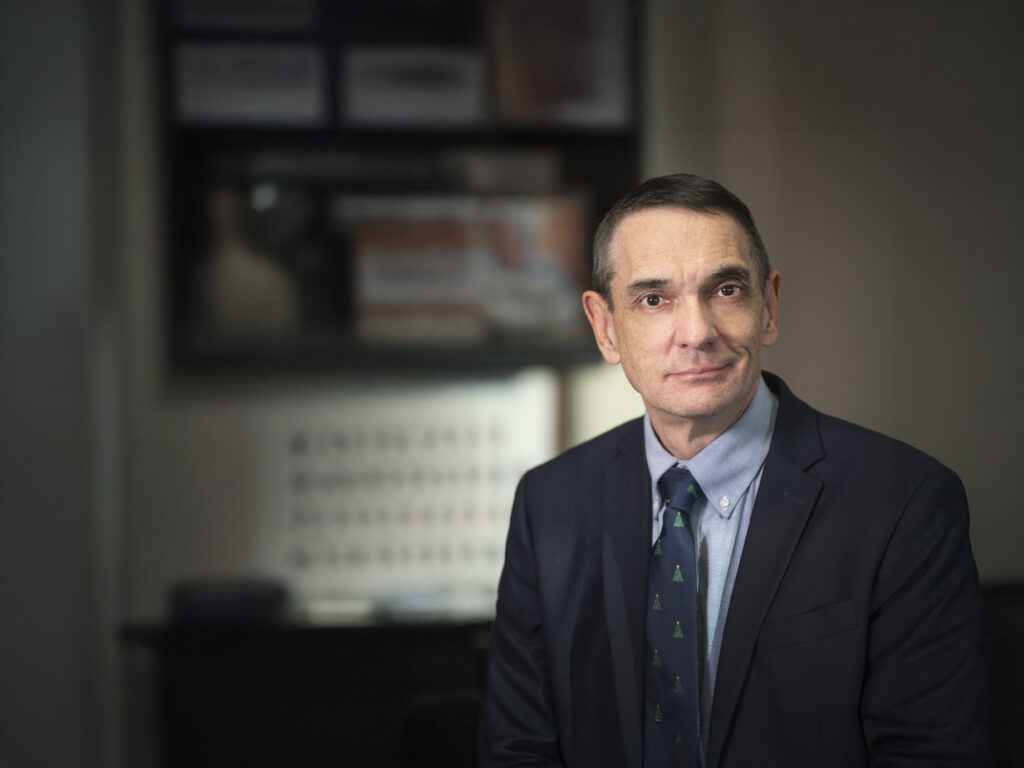

PARTNERS IN PHARMACY
Gerald V. “Jerry” Maloney,
DO, FACP
“[The pharmacist] is like the hidden guardian angel, saving lives. They’re as responsible for the fact that you got better as the physicians and nurses.”
-Dr. Gerald V. Maloney
Dr. Gerald Maloney has a unique perspective on the role of clinical pharmacists in healthcare. After all, he used to be one himself.
“I’ve been involved in a variety of roles over the years that have really helped me appreciate the evolution of the role of the pharmacist — from being the person in the basement doing dispensing to really being a key member of the clinical team, like they are today.”
Dr. Maloney entered pharmacy school right out of high school. Not long after graduating from Duquesne University, he went to work in a new hospital. It was an exciting time for clinical pharmacy, as he helped roll out new state-of-the-art services like unit dosing and IV admixtures.
However, at the time, he observed that pharmacists did not always get the same respect as physicians. In the wake of a critical medication error at the hospital, he offered to design and implement protocols to prevent such a mistake from happening again. Instead of being greeted with enthusiasm, the young pharmacist was reprimanded by an older doctor. “He said, ‘Don’t you dare try to elevate yourself on the back of the physicians.’ … That was one of the most memorable moments of my career.”
Fortunately, when Dr. Maloney came out of medical school a few years later, times were beginning to change. He noticed pharmacists were more visible in the hospitals where he practiced hospice and palliative medicine.
“The paradigm has completely shifted from dismissive, to tolerated, to accepted, to dependence and trust. And I think that’s where we are today.”
I’ve been involved in a variety of roles over the years that have really helped me appreciate the evolution of the role of the pharmacist — from being the person in the basement doing dispensing to really being a key member of the clinical team, like they are today.”
In his decades as a physician, Dr. Maloney has never forgotten his pharmacy roots. He’s grateful for all he learned in the first phase of his healthcare career.
“[As a pharmacist] I learned how to talk to people and I learned how to teach. I learned how to recognize knowledge gaps, both in patients and in other caregivers. And I learned how to diplomatically and constructively approach those people to make it more likely that my message would be heard. I learned that the way to acceptance is demonstration. Don’t let me do something just because I tell you I can do it — let me show you that I can do it, and then you can make your decision.”
As a health-system leader, Dr. Maloney makes a point of championing pharmacists and their contributions to the success of the interdisciplinary healthcare team. In his previous role as chief medical officer of Geisinger System Hospitals, pharmacists were instrumental in optimizing and implementing the medication reconciliation process to ensure each patient leaves the hospital knowing which medications to take and which to discontinue.
Another area of focus was antibiotic stewardship: choosing the most effective medication for the patient and infection, without incurring unnecessary complications or expense. Left to their own devices, he admits, many physicians gravitate to the “sledgehammer” solution first.
“We need the pharmacists to not only educate but also actually monitor the prescribing and make those suggestions to the physician. They can say, ‘Hey, wait a minute. We really have to hold this new, high-powered antibiotic back for cases where it’s really needed. Let’s try something else first.’ They put together a pretty robust program for that, and I told them I think it’s about 10 years overdue.”
We need the pharmacists to not only educate but also actually monitor the prescribing and make those suggestions to the physician.”
He’s proud to shine a light on the often-invisible role of clinical pharmacists among patients, too.
“I think it would amaze most people to understand that if [for example] you’ve just been in the hospital for two weeks, your care has been touched so many times by a pharmacist, and you may have no idea. [The pharmacist] is like the hidden guardian angel, saving lives. They’re as responsible for the fact that you got better as the physicians and nurses.”
Dr. Maloney wants young students interested in healthcare to know that pharmacy can be an exceptionally rewarding career.
“[As a pharmacist], you’ll learn so much that nobody else knows, and you’ll be able to use that knowledge to help people.”
Identifying gaps and demonstrating solutions to help people get better: From this physician’s perspective, that’s what it means to be your pharmacist.